

 Magfusehub.com – Complete Overview, Features, and Detailed Analysis
 TheSindi.com: Full Detailed Overview, Content Analysis, and Website Review
 R6 Marketplace Explained: Complete Guide to Rainbow Six Siege’s Trading System
 Pushwiki.com – Complete Guide, Features, Purpose, and Detailed Analysis
 Erin Maguire Fox News – Biography, Career, and Political Influence
 Your Topics | Multiple Stories: Complete Guide to Meaning, Writing Method, and Uses
 Cilxarhu677 Moisturizer Product — Complete Guide, Benefits, Ingredients, and Honest Review
 Yonosamachar com – Complete Guide, Features, Content Analysis and Full Review
 Constraint on Bavayllo – Complete Guide to Meaning, Types, Causes, and Solutions
 Tech Trends PBoxComputers: The Future of Smart Computing and Digital Innovation
Helonium: The First Molecule of the Universe and Its Hidden Scientific Power
Introduction
Helonium, scientifically known as the helium hydride ion (HeH⁺), is one of the most fascinating discoveries in the field of chemistry and astrophysics. It is not just another chemical compound; rather, it holds a unique position as the first molecule ever formed in the universe. This simple yet powerful ion represents the beginning of all chemical processes that eventually led to stars, galaxies, and even life itself.
Despite its importance, Helonium remains largely unknown to the general public. It does not exist naturally on Earth in any stable form, and its presence is mainly observed in extreme cosmic environments. Understanding Helonium allows scientists to explore the early universe and uncover how the cosmos evolved from a hot, dense state into the complex structure we see today.
What is Helonium?
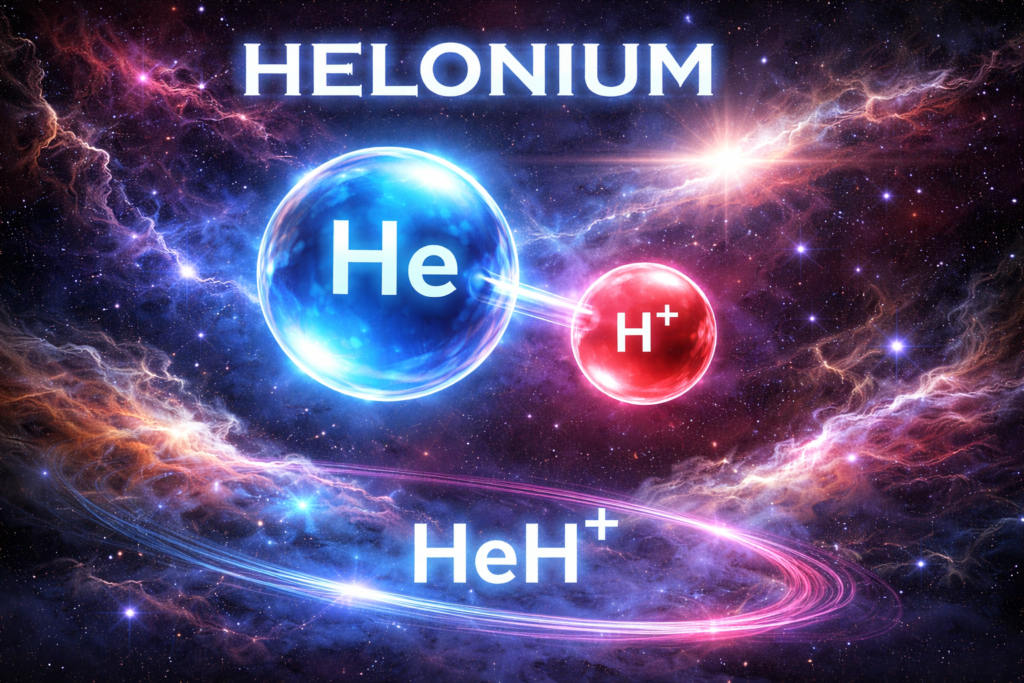
Helonium is the common name for the helium hydride ion, with the chemical formula HeH⁺. It is composed of one helium atom bonded to a hydrogen ion (proton). Unlike most molecules we encounter in daily life, Helonium carries a positive charge, making it a cation.
This molecule is extremely simple in structure, yet it behaves very differently from ordinary compounds. Helium is a noble gas and is generally unreactive, but under special conditions, it can form a bond with hydrogen. This rare interaction results in the creation of Helonium, a molecule that exists only in highly energetic environments such as outer space or laboratory simulations.
The Origin of Helonium in the Universe
Helonium’s greatest significance lies in its origin. Scientists believe that it was formed shortly after the Big Bang, making it the first molecular bond in cosmic history. During the early stages of the universe, temperatures were extremely high, and only basic elements like hydrogen and helium existed.
As the universe began to cool, helium atoms interacted with hydrogen ions, leading to the formation of Helonium. This marked the beginning of chemistry in the universe. Without this first step, more complex molecules would not have been able to form.
Helonium acted as a bridge, allowing chemical reactions to evolve and eventually produce molecular hydrogen (H₂). Molecular hydrogen played a key role in forming stars, galaxies, and the large-scale structure of the universe.
Structure and Chemical Properties
Helonium is a diatomic ion, meaning it consists of two atoms. Its structure is simple: one helium atom and one hydrogen ion bonded together. However, its simplicity does not make it weak or insignificant.
One of the most interesting properties of Helonium is its high reactivity. It is considered a very strong acid in chemical terms and reacts quickly with other molecules. Because of this, it cannot survive for long under normal Earth conditions.
Another key property is its positive charge, which influences how it interacts with other particles. This charge makes Helonium highly active in chemical reactions, especially in ionized environments like nebulae or plasma.
Discovery and Scientific Confirmation
Helonium was first created in laboratory conditions in 1925. Scientists were able to produce it artificially by combining helium and hydrogen ions under controlled conditions. However, for many decades, its existence in space remained theoretical.
The breakthrough came in 2019 when astronomers finally detected Helonium in space. It was observed in a planetary nebula known as NGC 7027. This discovery confirmed long-standing theories about early universe chemistry.
The detection of Helonium was a major milestone. It validated predictions about how the first molecules formed and provided direct evidence supporting models of cosmic evolution.
Role of Helonium in Cosmic Evolution
Helonium played a critical role in shaping the universe. Its formation marked the beginning of chemical reactions that led to more complex molecules. One of its most important contributions was helping create molecular hydrogen.
Molecular hydrogen is essential for star formation. It allows gas clouds to cool and collapse under gravity, leading to the birth of stars. Without Helonium, this process would have been much slower or even impossible.
In this way, Helonium can be seen as the starting point of cosmic structure. From this simple molecule, the universe gradually developed into the vast and complex system we observe today.
Why Helonium is Rare on Earth
Although Helonium is incredibly important in space, it is almost nonexistent on Earth. The main reason is its instability under normal conditions. Earth’s atmosphere and environment do not provide the extreme conditions required for Helonium to form or survive.
Additionally, Helonium reacts very quickly with other substances. Even if it were created naturally on Earth, it would not last long before transforming into something else. This makes it extremely difficult to study outside of specialized laboratory settings.
Helonium in Modern Science
Today, Helonium is primarily studied in the fields of astrophysics and theoretical chemistry. Scientists use it to understand the early universe and to test models of molecular formation.
It is also used in advanced laboratory experiments where researchers simulate space-like conditions. These experiments help scientists learn more about ion chemistry and the behavior of molecules in extreme environments.
Helonium’s study continues to provide valuable insights into both the past and the future of the universe. It helps scientists answer fundamental questions about how matter behaves under different conditions.
Simple Explanation for Beginners
In simple terms, Helonium is:
- A tiny molecule made of helium and hydrogen
- The first chemical bond ever formed
- The starting point of all chemistry in the universe
Even though it is very small and rare, its impact is enormous. Without Helonium, the universe might not have developed in the way it did.
Conclusion
Helonium is far more than a simple chemical ion. It represents the beginning of chemistry and the foundation of the universe’s evolution. From its formation shortly after the Big Bang to its role in creating stars and galaxies, Helonium has played a crucial role in shaping everything we see today.
Although it is rare and unstable on Earth, its importance in science cannot be overstated. The discovery of Helonium in space confirmed decades of theoretical predictions and opened new doors for understanding the cosmos.
By studying Helonium, scientists continue to uncover the mysteries of the universe, proving that even the smallest molecules can have the greatest impact.
FAQs
1. What is Helonium in simple words?
Helonium is a molecule made of helium and hydrogen that is believed to be the first molecule formed in the universe.
2. What is the formula of Helonium?
The chemical formula of Helonium is HeH⁺.
3. Why is Helonium important?
It started the first chemical reactions in the universe and helped form stars and galaxies.
4. Can Helonium be found on Earth?
No, it is extremely unstable on Earth and only exists in space or laboratory conditions.
5. When was Helonium discovered?
It was first created in the lab in 1925 and later detected in space in 2019.